Buying guide
Lithium vs lead-acid inverter batteries: what you actually pay over ten years
Cycle life, usable capacity, maintenance, weight and efficiency — a plain comparison of LiFePO₄ and lead-acid inverter batteries, and how to work out the real cost per unit of energy.
7 min readUpdated By the Powrio engineering team
Most Indian homes still run their inverter on a tubular lead-acid battery. It is cheap to buy, widely available and every electrician knows it. Lithium iron phosphate (LiFePO₄) costs more on the invoice — so the honest question is whether it costs less over the life of the system. This guide walks through the differences that matter and shows you how to compare the two on the number that counts: cost per unit of energy delivered.
At a glance
| Tubular lead-acid | LiFePO₄ (Powrio) | |
|---|---|---|
| Rated cycle life | ≈ 300–500 cycles | 3,000+ cycles |
| Recommended depth of discharge | ≈ 50% | 80% or more |
| Maintenance | Distilled-water top-ups, terminal cleaning | None — sealed |
| Weight for the same energy | Baseline | About one-third |
| Self-discharge | Noticeable within weeks | ≤3% per month |
| Gassing while charging | Yes — needs ventilation | No |
| State-of-charge display | Rarely | Built in |
1. Cycle life is the headline difference
A cycle is one full discharge and recharge. In a city with daily cuts, or on a solar system that cycles every evening, an inverter battery can go through 300 cycles a year. A lead-acid battery rated for a few hundred deep cycles is effectively worn out within one to two years of that duty; many last longer only because they are rarely discharged deeply.
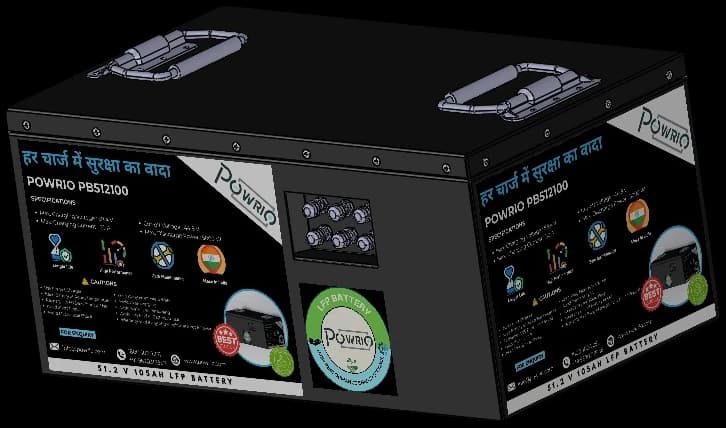
LiFePO₄ is rated for thousands of cycles. That is why Powrio packs are designed for 10+ years of service rather than a couple of seasons.
2. Rated capacity is not usable capacity
Two batteries with the same ‘Ah’ on the label do not give you the same backup. Lead-acid life falls sharply if you regularly drain it below about half, so a 150 Ah lead-acid battery realistically offers around 75 Ah of everyday use. LiFePO₄ is comfortable at 80% depth of discharge or more, so a 100 Ah pack gives you roughly 80 Ah — more usable energy from a smaller rated number.
3. Maintenance, space and safety
- Lead-acid needs distilled-water top-ups and clean terminals; missed maintenance shortens its life further.
- Flooded lead-acid releases hydrogen while charging, so it needs a ventilated spot — not a sealed cabinet in a bedroom.
- A LiFePO₄ pack is sealed, does not gas during normal operation and weighs about a third as much, so it can sit on a wall stand or in a neat cabinet.
- Powrio packs add TriShield protection — BMS, MCB and fuse — so faults are cut off at three independent levels.
4. Efficiency: less energy lost as heat
Every time energy goes into a battery and comes back out, some is lost. Lead-acid loses noticeably more than LiFePO₄, especially during the long ‘absorption’ phase at the end of charging. On grid backup this shows up as a slightly higher electricity bill; on solar it means less of your generation reaches the evening.
5. Work out cost per usable kWh, not price per battery
The fairest way to compare is the cost of each unit of energy the battery will deliver over its life:
Cost per kWh delivered = Purchase price ÷ (Rated kWh × Usable fraction × Rated cycles)
Run the numbers with real quotes. Take a lead-acid battery at roughly 400 cycles and 50% usable depth: it delivers about 200 ‘full-capacity equivalents’ over its life. A LiFePO₄ pack at 3,000 cycles and 80% usable depth delivers about 2,400 — roughly ten times as much energy per rated kWh. Even when the lithium pack costs two to three times more upfront, the cost of each unit of stored energy is usually far lower, and you avoid buying replacement batteries along the way.
6. Switching an existing inverter to lithium
- Check the inverter's battery voltage — 12 V, 24 V or 48 V class. Choose a Powrio pack with the matching nominal voltage.
- Check whether the inverter has a lithium or ‘custom’ charging setting. Correct charge and float voltages matter for any lithium battery.
- Size the pack for the backup you need (see our sizing guide).
- Have an authorised Powrio dealer install it and confirm the charger settings.
- Register the battery online the same day to activate your digital warranty.
The verdict
If your inverter is used only a few times a year, a lead-acid battery can still make sense. If you face regular cuts, run solar, or simply do not want to maintain a battery, LiFePO₄ is the better long-term buy: more usable energy, no maintenance, far longer life and a lower cost per unit of energy.